Friday, 13 July 2018

अंतरिक्ष यात्रियों की जान बचाएगा ISRO का यह कैप्सूल, परीक्षण हुआ सफल

ISRO conducts first successful escape test for India's manned mission to space- Khabar IndiaTV
अंतरिक्ष के लिए अपने मानव मिशन लक्ष्य की दिशा में भारतीय अंतरिक्ष अनुसंधान संगठन (ISRO) ने एक बड़ी कामयाबी हासिल की। ISRO ने गुरुवार को अंतरिक्ष यात्री बचाव प्रणाली (क्रू इस्केप सिस्टम) की सीरीज का पहला परीक्षण किया जो सफल रहा। इसरो ने एक बयान में कहा कि क्रू एस्केप सिस्टम की विश्ववसनीयता और प्रभावशीलता को परखने के लिए सिलसिलेवार परीक्षण में यह पहला अभियान था। अंतरिक्ष एजेंसी ने कहा, ‘यह लॉन्च के असफल होने की स्थिति में अंतरिक्ष यात्रियों के साथ क्रू मॉड्यूल को जल्दी से परीक्षण यान से निकालकर सुरक्षित दूरी पर ले जाने की एक प्रणाली है।’
इसरो के अनुसार, ‘प्रथम परीक्षण (पैड निष्फल परीक्षण/पैड अबॉर्ट टेस्ट) में लॉन्च पैड पर किसी भी जरूरत पर क्रू सदस्यों को सुरक्षित बचाने की क्रियान्वयन को दिखाया गया।’ इसरो के अनुसार, 5 घंटों की उल्टी गिनती सुचारु रूप से हुई। इसके बाद यात्री बचाव प्रणाली ने श्रीहरिकोटा स्थित सतीश धवन अंतरिक्ष केंद्र से सुबह सात बजे 12.6 टन की क्षमता वाले कृत्रिम क्रू मॉड्यूल के साथ उड़ान भरी। परीक्षण का समय 259 सेकंड रहा, जिस दौरान यात्री बचाव प्रणाली ने अंतरिक्ष में ऊंची उड़ान भरी और बंगाल की खाड़ी में वृत्ताकार घूमते हुए अपने पैराशूट्स से पृथ्वी पर वापस लौट आई।
परीक्षण उड़ान के दौरान लगभग 300 सेंसर ने विभिन्न मिशन प्रदर्शन मानकों को रिकॉर्ड किया। इस दौरान तीन रिकवरी बोट भी तैनात की गई थी। इसरो ने कहा कि मानव को अंतरिक्ष में भेजे जाने की दशा में उन्हें सुरक्षित भेजना और वापस धरती पर लाना हमारी पहली प्राथमिकता है, और ऐसी दशा में हमें लाइफ सपोर्ट सिस्टम देना होगा। इसरो ने बताया कि यह मॉडयूल भारत के स्वदेशी मानव अंतरिक्ष मिशन में अहम भूमिका निभाएगा। इस परीक्षण में यह देखने की कोशिश की गई कि अंतरिक्ष यान की उड़ान के दौरान अप्रत्याशित घटना या दुर्घटना के वक्त क्रू को कैसे सुरक्षित बाहर निकाला जा सकता है।

Thursday, 12 July 2018

Groom young Indian students to take interest in space, astronomy: Former ISRO chief Kasturirangan

Former Indian Space Research Organisation (ISRO) chief K Kasturirangan talked about India's space scene and how it is bound to reach places in the coming future.
Kasturirangan said that Indian students can reach for the skies if inquisitiveness is provided to them. The interest in astronomy if is instilled in them right from the school days, the students can really go big in the field of space and astronomy.
"I think this is an extraordinary period of astronomy for India but what is important now is that we need to groom the younger generation to take an interest in astronomy, to bring them into astronomy and do justice to all the investments we are making," Kasturirangan said.
INTEREST IN ASTRONOMY AMONG THE YOUTH
Kasturirangan said that for India to be "right in the forefront" of astronomy, it is important for us to get the youth into astronomy and draw their interest in it.
The former ISRO chief also talked about the field being expanded with planetary explorations to grow further in the coming years. Making use of this prediction, the scientist said that there was a great scope for youngsters in the field of astronomy.
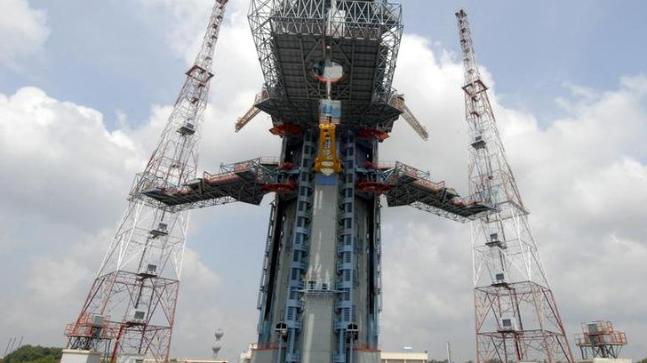
The PSLV-C11 (Polar Satellite Launch Vehicle), Chandrayaan-1 sits on the second launch pad of Satish Dhawan space centre at Sriharikota, about 100 km north of the southern Indian city of Chennai, on October 11, 2008.
Kasturirangan mentioned that there is a need to promote the astronomy among youth. For that, the government should promote activities right from the schools, in colleges as well as universities and other research areas.
"I think even areas such as planetary explorations will further grow. And so there is a lot of scope and a lot of excitement in this but the youngsters have to be motivated right from the schools. We should promote astronomical activities in the universities, research areas, institutions," he said.
We need a large number of youngsters from the university system, institutions, observational institutes.
- Kasturirangan
INDIA AND SPACE EXPEDITIONS
When Kasturirangan was asked about if India was capable of taking up space expeditions and research work on its own, he said that ISRO will need to partner with other nations after a certain point, even if India manages to reach that position.
I would say up to a point India is capable of taking up space expeditions single-handedly. But I think at a certain stage India must move towards international collaboration and cooperation.
- Kasturirangan
"Chandrayaan had six instruments from abroad and six from India... I am sure that future Mangalyan and other planetary explorations will have (collaboration). And afterwards I believe we will be a part of an international expedition to planetary exploration," Kasturirangan said.
Kasturirangan asserted on a fact and advised the government that India should not go in for loans to facilitate space research programmes.
We should not take loans because investments are very large and the resources can be very demanding.
- Kasturirangan
He talked about India demonstrating its capabilities in the field of astronomy.
"I don't think there is any reason why we should when the international community also looks to collaboration with India because Indians are easy to collaborate with, are capable and can contribute substantially to major programmes."
Underlining India's strong presence in international space programmes, the Padma Vibhushan awardee of 2000 predicted tremendous opportunities for the country in this field.
He referred to India's participation in the Thirty Metre Telescope (TMT) project, a proposed astronomical observatory, mentioned the Square Kilometre Array, a large multi radio telescope project and said India was a partner for the Laser Interferometer Gravitational-Wave Observatory (LIGO) to detect cosmic gravitational waves.
PSLV-C25/Mars Orbiter lift-off.
"I think others will come here and they will be partners here of an Indian-inspired thing. And may be tomorrow there will be an astrostat in which others will come and participate. So just look at the things we are doing. So I think there is tremendous opportunity and the international community is very much inclined to do this," he stated.
ISRO AND RESOURCES
According to a few reports, it comes to light that ISRO's resource constraint has continued to ground its human space flight venture.
AS Kiran Kumar, who retired as ISRO Chairman earlier this month, said that ISRO is working on some of the critical technologies for the human space flight, such as crew module and environmentally-controlled chamber but also mentioned how the space agency's priority continues to be strengthening its observation, communication and navigation capabilities.

Wednesday, 11 July 2018

STEM Educators: India On The Road For Progress

Image result for stem education
Subjects like science and math have been taught in school since the beginning, but recently there has been a vast difference in the way of learning. Now, students can very well experience the different connotations by ‘doing & learning by themselves’. This is where Science Technology Engineering Math (STEM) education comes into use.
STEM: Better Late than Never
STEM Education’ is relatively a new term in the Indian education sector, which has picked up quite a lot in the last few years. In contrary to the belief that India produces the highest number of scientists & engineers, the growth of STEM education had been slow till few years ago. However, in the last decade or so, with the popping up of many STEM education companies in the country, Indian education system is on the right track for development.
STEM Learning- Need of the hour
According to the National Science Foundation, it is predicted that 80 per cent of the jobs created in the next decade will require some form of math and scienceskills. Despite having the best of the brains in India, the exam focused education model had limitations related to innovation, problem solving and creativity. This is where the STEM players like Edutech, Creya, Stem Learning, Stem Champ and many others come in to fill this gap. In words of Sajeev Karuthody, Director-India, Edutech, “We were able to foresee that scope of technology in Education should be beyond implementing ICT infrastructure in education. Instead more profound impact can be achieved by introducing ‘Hands On’ application based learning – STEM. We introduced hands on learning platforms for K12 like Robotics, hands on tools to understand and apply basic concepts like wheels, gears, machines and mechanisms, digital science labs and now 3D printing, design and technology, tinkering labs and maker space labs.” On the same lines, Venkatesh Datla, Founder, Creya says, “I and the other co-founders had the opportunities to not only study education systems across developed countries, but also India as well. One of the insights we had about our K12 students was the inability to apply classroom concepts to real world problem solving. The second insight was that our students do not appreciate the need of interdisciplinary approaches to solving real world problems. For addressing both these issues, we felt STEM programs were a good fit as long as we aligned it to our curriculum framework, instead of blindly copying from the west.”
STEM Innovations for best results
It is essential that all STEM companies incorporate portfolios which cater to end to end STEM and ICT learning requirements of any institution. Since the last few years, STEM companies have been incorporating innovative techniques for making kids more entertained as well as interested in the ‘do it yourself’ way. Karuthody of Edutech quotes, “With the fourth industrial revolution coming in, we need to prepare our students to do innovative jobs and not commodity jobs. Using STEM we can empower our students to solve the real life challenges using the knowledge learnt in schools and colleges.”
Few of the innovations, after speaking to the experts are mentioned below:
- Education sector is looking beyond smart classrooms towards hands-on learning and STEM, enhancement on their current ICT and smart class platforms like VR and AR.
- STEM companies working with schools to help them setup STEM Centres, tinkering labs and adding the upcoming technologies like VR and AR.
- Help educational intuitions to upgrade their library infrastructure with more engaging learning assets and management tools.
- Enable the educational institutions cater to their digital learning needs by implementing Learning Management Systems, assessment systems, language labs, library management system, Gamification etc.
- Programs designed to ensure that schools don't need to buy multiple projects of Robotics, Science Activities, Math Lab, Soft Skills lab, Photography or programming. Ensured all of these are combined in a seamless experience of project based learning and delivering it a full suite solution that has the manipulative parts, the project curriculum and the implementation support.
Regarding innovations, Datla enlightens, “Creya Learning is the pioneer in the space of STEM learning and 21st century skills being intact the first one to set-up Design studios long before talking about Design Thinking in K12 Education became fashionable. Our programs have been experienced by about 100 schools, all over India.”
Hurdles on the way
As mentioned earlier, there has already been a delay in incorporating STEM studies in schools. The cause can be the many hurdles that have been on the way. One of the biggest challenge involved in implementing STEM education is to design infrastructure, curriculum and to provide kids the best guidance and support. Another challenge can be funding, schools need money for construction of Makerspaces, DIY (Do it Yourself Tools), best computers etc, which are some of the basic aspects of the STEM education. On the hurdles faced by Creya, Datla says, “Some of the road blocks and limitations are more of a mindset initiative. For example schools cite lack of time or space for incorporating a STEM program. One of the ways of overcoming the limitations is by investing in educating the ecosystem about the need for such programs. We can also consider using summer and winter breaks for these STEM programs where schools have constraints during school hours.” Another hurdle as pointed by Karuthody, “Many of the educators still think that by introducing STEM, students will get diverted from their studies and they would not be able to complete their defined curriculum in that stipulated amount of time. The only way to address this is by making them aware and changing their beliefs by showing them the positive results of introducing their kids to STEM learning methodology.”
Eying the future
Being the second most populous country with unmatched talent and culture, India needs a combined support from government and other education societies to avail the opportunity and benefits of STEM education. Now, with the Government of India also focussing on campaigns like ‘Make in India’ Innovation Mission, there is focus on developing innovation and manufacturing right from schools, skilling centres and higher education. There have been encouraging programs to implement Maker spaces, tinkering labs in this direction. Moreover, private schools are taking lead and implementing Robotics, Digital science labs, maker space etc which have a cascading effect.
To conclude, it can be said that overall a culture of application based learning and innovation is spreading amongst the schools, students, colleges and teachers which is definitely a strong signal that the future of STEM technologies and adoption in India is very bright.

Tuesday, 10 July 2018

FIVE REASONS TO TEACH ROBOTICS IN SCHOOLS

In today’s’ technology-driven world, it’s important now more than ever to prepare students for the future. Teaching robotics to young students throughout their schooling can increase their ability to be creative and innovative thinkers and more productive members of society. Many governments have already recognized the importance of robotics in the classroom and have begun to create programs and laws that would incorporate it into their public education system. By teaching our students the basics of robotics, we can open a whole new world to them and exciting opportunities that they wouldn’t have access to otherwise.
1. An Introduction to Programming
Learning to program a computer is an excellent skill to have to make students more likely to get a job in the future, and earn more money in their lifetime. Teaching young students the abstract subject of programming can be a challenging feat. Programming is often too complex for most students to grasp. Robotics is a simpler to understand and more tangible introduction to programming.
When students program physical robots, it’s easier for them to see what goes wrong as they learn what robots can and cannot do. They learn the skills needed to create precise and accurate instructions and have fun while learning valuable lessons. Teaching robotics in schools gives students the opportunity to address the growing demand of teaching STEM subjects while learning how science, engineering, math, and technology work together and interact.
2. Increases Creativity
Robotics is a production-based learning module. Students have the opportunity to create something tangible and make it perform the actions that they program it to do. Not a lot of fields combine creativity with engineering and technology—robotics does. When students are given the opportunity to create something interactive that they think is cool, their engagement levels increase, and they retain more information. You might be surprised at the things kids can create when given the right information and tools.
3. Prepare them for the future
It’s no secret that jobs in the STEM field are the fastest growing careers, and are projected to grow another 17 percent in the next decade. Industries such as the drone industry has grown dramatically and rapidly in the last couple of years. The Economist has reported that more than 15,000 drones are being sold in the US every month. Growing industries such as these are going to need people who can come up with new and innovative ideas, and be equipped with the knowledge to design and create the technology needed.
By the time all of our students graduate in a few years or so, over half of the available jobs will be in the STEM field and a large chunk of the rest will require employees to have some STEM knowledge. When students are introduced to robotics in their school years, they can discover any interests and talents that they may have in this job market. Without the knowledge or access to robotics education, there’s no way for students to build interest in these fields. Without robotics education in public schools, who knows how many potential creators and innovators there are who were never given the resources to realize their potential.
4. Teaching Children How to Turn Frustration into Innovation
Learning how to build and program a robot can be a complex and difficult process. Many students will struggle with the concepts at first and often get frustrated. Robotics in schools can help these students turn their frustration into creativity and innovation. This is a valuable life lesson that teaches our students perseverance and determination when faced with challenges. Students learning robotics are able to channel their frustration into trying harder and aiming higher. All their hard work makes looking at that finished product even sweeter at the end. Not only does teaching students robotics teach them how to persist and solve problems, but it also helps them increase their maturity levels and prepare them for real-world situations.
5. Promoting Inclusivity
Robotics is a field that is easily accessible to a wide range of students with varying talents and skills. Studies have shown robots do a great job of engaging students on the autism spectrum. Children with autism are able to easily respond to the consistent, calm, and clean interactions that robots give them. Robots like ASK NAO and Milo have been developed to aid autistic students with learning and understanding their emotions.
Robotics is also a field that has the ability to empower young girls in the classroom. STEM-focused fields are traditionally male dominated, leaving young girls to question their ability to program or build computers. Because the tech world is not one that focuses on or is created for girls, by engaging them with robotics and technology in the classroom we can begin to change that. When girls realize their ability to build robots and program, they are empowered to have successful futures and create innovative technology.